28 July 2008

Till Sverige!


It will be two weeks tomorrow that I’ve been in Sweden and I can hardly believe that so little time has passed as it seems much has transpired. It’s a gorgeous Swedish summer with puffy clouds, blue skies and sparkling water. My time so far has been consumed with a rather trying search for housing which I’m happy to say has concluded with pleasant, if expensive results. The housing market is controlled by the government, which keeps rents low but leaves little to be offered to outsiders except illegal and overpriced sublets. Add to that the fact that I arrived at a time when most Swedes are out in the archipelago at their summer homes and it feels like I’ve been looking for a needle in a non-existent haystack. My Swedish friend Katarina came to my rescue by sending e-mails asking everyone she knows in Stockholm if they had a place for me. I’m staying with a wonderful woman named Lotta in Ektorp, which is just a few kilometers east of Stockholm. I’ll be here until the end of August and then I have a place of my own in a part of the city called Östermalm. It’s a swanky neighborhood, high rent, very central and close to the water (though there’s little that isn’t here) as well as several great parks. Djurgården is a large-ish island, very close to my place with miles of waterfront running trails and lots of huge old villas and a palace. Perfect for marathon training. I’ll have to move again, just before Christmas, but the International Programs Coordinator at KTH seems to think I’ll be able to get a student apartment by then. So, a month in what feels like the countryside and then the rest of my time right in the heart of the city. Perfect.

Lotta is a lighting designer and just sent her 17 year old daughter off to Sacramento for a year as an exchange student. She’s probably very close to my age, perhaps just a few years older, and she has a lovely, apartment in a building that was built in the 1930’s. It is contemporary Swedish, lots of IKEA, great wallpaper and minimal detailing. There’s an inlet of the Baltic Sea about a 5 minute walk away and a cycling trail that goes straight into Stockholm. Lotta is away for a couple of weeks, at her summer house near Gavle and so for the moment I have the place to myself. She works in an office with several other designers and has promised to take me there to see what they do. I’m happy for the arrangement as she seems so kind and it’s nice to make some Swedish friends. I’ve spent the past couple of days schlepping luggage and getting settled in—shopping for food, wine, a coffee pot, towels, etc and settling in with a nice bath and and some much needed sleep. I’ll recount my hostel stay another time but suffice it to say I spent six days in a room with a Born Again Christian who felt compelled to espouse her (and God’s) views on Stockholm’s upcoming Pride Festival so you can well imagine how we got along.

Yesterday I did my first serious run in preparation for the Nice to Cannes Marathon in November. It’s six miles into Stockholm from here and so I ran the round trip before it got too hot to be out. Today was my first day of getting to work and I have to say it feels great to get going. I have much to do, but for now at least, my motivation is strong. I met with Torun Warne, the director of the Arkitekturmuseet, and she was very generous in offering support for my research. The archive is closed until mid-August, which gives me some time to read and get back into this material.

My missive wouldn’t be complete without mentioning something about economy, exchange rates and the pathetically weak dollar. Stockholm isn’t the most affordable city to begin with and at 6 SEK to the dollar it borders on ridiculous. I’ve done my best to be frugal.


Here are some specifics:

taxi from Central Station to Hostel (1.5 km) 140 SEK $ 23.33
one night in a 6-bed dorm 240 SEK $ 40.00
glass of wine 46 SEK $ 7.60
Emmental cheese 350g 40 SEK $ 6.60
small Barilla pasta sauce 23 SEK $ 3.80
zucchini per kg 20 SEK $ 3.33
milk 1 liter 8 SEK $ 1.31
baguette 17 SEK $ 2.83
load of laundry 35 SEK $ 5.83
my running shoes ($95 in US) 1200 SEK $ 200
hair gel 40 SEK $ 6.60
one month of internet 295 SEK $ 49.16
fee for taking cash from ATM $ 5.00

06 March 2007

February's long good-bye

The shortest month of the year nearly burst its seams. It began with preparations for an interview with Juhani Pallasmaa focused on Lewerentz that will be published later this year. The result exceeded my most optimistic expectations and now the task of transcribing over 2 ½ hours of audio awaits. Paper deadlines followed, pushed forward by my family’s arrival here in Helsinki. My sister had barely been here a day when as bad timing would have it, we happened into a large multi-story shopping center just minutes after a middle aged man had jumped to his death. A rather inauspicious, not to mention morbid and disturbing start to her vacation. My brother and his wife arrived that same evening and after a day of seeing Helsinki we all piled into a train bound for Russia.

I watched Viipuri run out through the window and after a long stretch of forest we emerged on the outskirts of St. Petersburg. Everything was huge. Giant apartment blocks, wide streets, big skies and hundreds of filthy little cars. From Finland Station we walked across the Neva. It was as wide as the Columbia and frozen solid. 18th and 19th Century buildings lined the banks in various states of grandeur and colorful disrepair. Canals cut through the southern part of the city making it into a caricature of Venice inhabited by stinking automobiles and filled with noise. Every block had a little booth, sometimes sturdy other times cobbled together, from which someone kept an eye on the street. Suspicion lingered in the frozen exhaust infused air. Crumbling courtyards overflowed with piles of dirty snow and twisted and rusty debris. Uniformed men filled the sidewalks and alleyways. Around a final corner a plaza that could hold a half dozen Place de la Concordes opened up, the beautiful and strangely green Hermitage on one side and an endless arching yellow building on the other. From time to time a furious motor would propel a car or van straight from the last world war around the vast space. People scurried out of the way scolded by hollow aggressive horns.

Nighttime and crisp air cast a surreal glow on the city and its gleaming gilded domes. Cyrillic signs kept even the most benign and banal shrouded in their secret code. Pectopah repeated over and over. It must be something serious and related to the government, I mused. I was intrigued and tried to crack the code. B as in van. H as in Napoleon. P as in restaurant. Or Restoran or Pectopah.

Wanders through miles of art filled hallways and arrays of strange 17th century medical specimens were punctuated by sifting through old coins, worn icons, hat shops and plates of dill. Minus 18° C, again. Fur starts to make sense and vodka for breakfast sounds good. We descended deep beneath the streets and into old blue metro cars and made our escape.

We emerged in Tallin, which puts Disneyland to shame. It was perfect. Our apartment was gorgeous, stone walls and timbered ceilings with a view to a medieval church and its accompanying 18th Century chapels. Friendly faces, familiar words with mixed up meanings, wooden toys, wool socks, linen everything and cozy coffee shops. We wandered, cooked, took saunas and regrouped. Then back into the unknown on a bus bound for Riga.

We pulled in from the east and it looked like we’d perhaps landed back in Russia but that first impression was quickly dispelled as we walked past the medieval center, through the 19th Century parks and boulevards to our apartment. Riga was a balmy +1° C and after what we’d become accustomed to it felt like spring had arrived. After some minor difficulties getting into our apartment we wandered back out to find dinner. For just a few Lats we found great food (only a little dill this time), amazing beer and BALZAM! Balsam is an herbal concoction that our guidebook described as “thick as custard and guaranteed to knock the hind legs off a donkey.” They may have exaggerated a little—not so thick and as we don’t have hind legs that part of the theory remains untested.

Riga is home to one of the longest running markets in Europe. It was originally in the medieval town square before it moved to the banks of the Daugava where it flourished for over 350 years. Having grown so large, the city bought 5 zepplin hangers in the early part of the 20th Century to house the market. The buildings are incredible and you can find any kind of meat or fish imaginable, as well as some you might not want to imagine. Clothing, jewelry and magazine stalls mix with butchers, bakers and sellers of canned goods, coffee and tea. It was a feast for both the eyes and the stomach.

Riga’s medieval town is mostly intact and a few buildings have been rebuilt to replace ones ruined in the various and many conflicts that mark the city’s history. It was part of the Hanseatic League and guild houses mingle with churches, schools and some newer art nouveau apartment blocks. But the surprise highlight of Riga was the unbelievable Jugendstil buildings built by Sergei Eisenstein’s father, Mikhail. Turns out he was an architect, and a rather prolific one at that. Concentrated in just a few blocks are more buildings than you could shake a stick (or three cameras) at. Most were in pristine condition but a couple were mildewed and falling down—heartbreakingly beautiful! I must have run through 4 rolls of film in less than an hour.

My family has gone home now and I said good-bye to Juhani yesterday. Parting is such sweet sorrow. Just a few days left to bid farewell to this sparkling gem of a city and this European dream. Thank you Valle! It has been unforgettable.

15 February 2007

Kaupunki

With so many surfaces for my eye to caress, the city shows me something new each day and over time it reveals me to myself. What I once thought overwrought I now find beautiful and what I didn’t like or disagreed with has new resonance with me as I change and familiar things persist. The city and I are like lovers; by noticing things our intimacy grows and we possess one another. It shows me who I am and who I might be and who I am here.

09 February 2007

Olen Työssä


Talvi

January 21, 2007

In spite of the sun’s rapid return winter has finally come. Helsinki is freezing and the bay has begun to ice over. I’ve never seen anything like it. The grey sea is indistinguishable from the sky and the big boats loom like distant shadows. All of the trees are frostbitten, dusted perfectly white atop their black trunks. The fishmongers still come to Kauppatori each morning but the bread lady doesn’t brave this cold and the souvenir sellers are fickle. It feels quiet and a bit sleepy except in the parks, where in spite of the bitter cold children with sleds and patient parents abound. There is a certain pride here in weathering the cold and it is not something that the Finns shrink away from—quite the opposite in fact. They see swimming in the ice as something that strengthens you and makes you better able to keep illness at bay and I’ve seen people more than twice my age out for a dip in the morning. The colors have all changed to soft pastels and compositons of white on white or ghostly fields of grey. But on a rare day when the sun shines it’s all blue and white.

Joulu

December 20, 2006

December has been unseasonably warm and well, dark. You can miss an entire day if you’re not watching for it and in spite of the eternal nocturne I can’t sleep. I wait until after 1:00 am to go to bed and find myself up searching for a book at 3:00 am. My shadow at noon is at least twice as long as I am tall and if the sun burns through the clouds it stares at you head on. Still any sun is welcome and everyone is out during daylight regardless of conditions. I’ve conformed to the Helsinki fashion of cladding yourself in reflectors, since so much of the day is night. The city is all dressed up for the holidays and in this bottomless darkness Helsinki sparkles.


The Christmas market fills Esplanadi Park and is bustling well into the evening. Everything you could possibly imagine made of wood is for sale there—one man makes the most amazing little birds with delicate wings out of one piece of wood that he then fans out by overlapping and hooking each piece onto the next. And the food! I can’t believe what I’ve seen!

Deepfried sardines, giant pancakes with berries and cream, cloudberry syrup and the most amazing honey…and of course, lots and lots of hot coffee. Everyone is very friendly and they’re happy to talk to you, barely pausing even after you tell them you don’t speak Finnish. Still somehow you can make sense of it. I pass through the market almost every day on my way to and from Juhani’s office just to peek into all of the little booths. Christmas in Helsinki is delightfully warm.

08 February 2007

Matter & Form

December 13, 2006

Last night I heard Juhani Pallasmaa lecture for the first time. I was at his office working in the afternoon and he suggested that we ride together to the university so that we would have a chance to talk on the way. He has been preparing a biography on a late painter and close friend for an upcoming retrospective exhibition—a rushed project that has left him time for little else. As it turns out, this very thoughtful and meditative man is a rather aggressive driver. He seemed surprised that we made it there so quickly.

His lecture was on matter and form and from the first word I was spellbound. I’ll try here, as best as I am able to recount the highlights.

He began by recalling Bachelard’s distinction between the material and the formal imagination, explaining that where matter dominates things tend to become primitive and clumsy and unarticulated. Where form dominates they tend toward kitsch and sentimentality. He illustrated his point with two images; the first of Michelangelo’s famous Pieta, the second of his lesser known and unfinished Rondanini Pieta. He boldly called the former kitsch, explaining that marble too easily became skin, that one only saw the form; the matter had been lost. But the second unfinished Pieta had a tragic quality as a result of the unresolved struggle between the stone and the form that was only beginning to emerge from it.

He told us that Adrian Stokes, in his book The Image in Form, speaks of carving and molding. Carving, he said is subtractive and reveals what is hidden in the material while molding is additive and builds up the image. He said that thinking too is either additive or subtractive—an interesting idea that made me think of the epistemological shift from deductive to inductive reasoning. To these categories Juhani added a third: constructing. It is neither carving nor molding but is closer to the latter. This, he said is what architects do. Architects must go between carving out and building up as they imagine space and then configure its construction. He showed images of Indian temples cut out of solid rock and said that there was an extraordinary power in environments made of one material or where the material and form are so like the landscape that it becomes impossible to say where one begins and the other ends. I immediately thought of Mont St. Michel and of Lewerentz’s St. Peter’s. Juhani’s first example was Aalto’s Saaynatsalo Town Hall, made almost entirely of brick the winds around a small hill to the point of making earth indistinguishable from the structure. His second example was Lewerentz.


He continued, showing two images, the first of a modern functionalist home, the second a photograph of a ruined interior, burnt out and water soaked with vestiges of furniture strewn about. He explained that images of chaos, erosion or lack of order were evocative, that these poetic images open imagination, while commercial or political images ask only for complicity and effectively shut imagination down. He showed pictures of the interior of a chimney-less hut, reconstructed here in Helsinki inside the Finnish National Museum. It had become blackened over time by smoke and had very small openings for windows. He said in such darkness that light became precious—like a diamond, that the room approached the viewer and asked for interpretation instead of presenting a clear and complete image.

He recounted his own experience at the temple at Karnac where there was such a fusion of matter and space that his sense of self had simply vanished. Time there was the experiential dimension. Time he said is poorly represented by form—matter is about time. He recalled the Arte Povera movement where matter was radically reintroduced into art and then spoke of how his grandfather would read the forest in terms of the objects he would carve from the trees. This one having the perfect curve for the lip of a sledge, or that one for the leg of a chair.

He showed several images of containers made from weaving birch strips, fish traps made of twigs and of a fisherman’s wooden lunchbox, shaped like a boat and made to float, rather than take on water. He wasn’t suggesting that these objects were finer that those we could make today. He wasn’t lamenting the loss of craft. His point was to show how the form and the material worked in tandem and gave equal consideration to function and beauty. He finished by telling us that species do not survive by regression. “Sustainaibility” he said, “relies on refinement.”

He took the long way back to Helsinki, passing by Seurasaari on the way, before dropping me off at Kamppi.

17 January 2007

Forsbacka


29 October, 2006

It’s about thirty minutes by bus from Gävle to Forsbacka. I got off the bus at the Forsbacka Konsum and went inside to ask for directions. In spite of an impressive command of English the two women I spoke to inside had great difficulty explaining how to get to the cemetery. They pointed me in the right direction and said that maybe I could find someone further up the road to ask again. So, with very vague instructions to “Stay right.” and “Cross the water.” I headed up Gavlegårdna. After a few blocks of residential flats set in large lawn-covered gardens the road dog-legs to the left. I kept to the right of the most curious and beautiful building that looked like and old brickworks. This building had at least six cone shaped chimneys and three detached smoke stacks, all heavily ringed with iron bands. There was an amazingly still lake on my right that doubled everything on its shores in a perfect mirror image. As I rounded the factory, the cone-shaped chimneys opened up. Each one had a magnificent cast iron pulley system inside of it. The road curved to the left behind the factory and then wound back to the right and led to a bridge spanning a narrow spot of the lake. Past the bridge to the left, water was rushing over and under a small footbridge. It was muddy and violent and as I approached I could see that the large bridge was actually a dam and the glassy lake was being sucked under it and shot back out toward the footbridge and on into another lake. I passed over the bridge with a quickened step assisted by a shot of adrenaline from the rushing water.

On the other side, a big white three-story manor sat directly ahead with a footpath leading into the woods to the left and a road that continued beyond it on the right. Remembering the instructions I’d been given, I stayed to the right and on the road. There were several beautiful homes next to the lake and a man in front of one of them raking a long gravel path. I wondered if he spoke English so that I might ask again about the cemetery and before I could decide whether or not to bother him he waved and shouted “Hej!” I said hello back and turned down his path. He said he only spoke a little English but gave me two sets of directions to the cemetery and asked where I was from. I thanked him, he told me (curiously) to “Have fun!” and I walked back to the path that led through the woods behind the big white house.

The path forked into an upper and lower way, the upper leading to two yellow houses on a ridge, the lower through a narrow path of birches growing out of a swampy wetland. There were two stone buildings dug into the ridge that looked like tombs, faced with black stones and matching underscaled green doors. I followed the lower path past the swamp and a little stream, up a steep hill to Forsbacka Wärdshus. Four yellow buildings were gathered around an open court with a hotel and restaurant inside. Just past the Wärdshus I caught my first glimpse of the tiny chapel. It sat at the end of a lane lined with white birches still clinging to the last of their yellow leaves. It was square instead of round or hexagonal as I’d expected. I took several photographs and walked toward the chapel.


The lane opened up with room to park six or eight cars on either side of the road. It was just after 1:00 pm and the sun was as high as it was going to get. The shadows were long and stretched northeast. I followed the stone cemetery wall on my left to where it opened before terminating in the circular enclosure that reached out from the chapel. The wall was made of flat wide black stones and had a mature layer of sod on top. The chapel sat high and right, the bell tower to the extreme right, off-site really, next to the caretaker’s quarters. It was simple and spare, but beautiful; a place for solemn repose. The low path, to the left of the chapel led down the hill to a stairway. The stairway, outside the kyrkogården wall, led right down to the water. The cemetery seemed to reach from the edge of town all the way to this quiet lake and I finally understood why the women I asked had had such difficulty explaining how to get there.


The square chapel sat about a meter above the highest point of the cemetery and its circular stone wall enclosed a flat lawn crossed by two perpendicular paths. Sixteen benches sat inside the circle, facing into the center. The chapel was nearly three times as tall as it was wide and almost completely solid except for a small window over the door and another larger window in the southwestern wall that rose high over the arched door of the cellar, a story below. The cemetery was well kept, with a steady stream of people coming to tend to the graves, bringing flowers and lighting fresh candles. It was surrounded by cheerful yellow houses and there were men fishing on the lake. I made several photographs in the warm light and sketched until my hands were too cold to hold my pencil. Reluctantly, I walked back toward the Wärdshus to warm up.


I entered the quiet courtyard and walked up the steps to the restaurant. I poked my head in and asked a small grey-haired woman if it was possible to get coffee and warm up for a bit. She said of course it was and told me to go upstairs. The creaky wooden building was filled with warm smells of cooking and at the top of the stairs I found a beautiful large wooden room, with a painted ceiling, several Victorian sofas and tea tables, a row of windows that looked out over the cemetery and a huge table filled with coffee cups, saucers and gingerbread biscuits. I giggled with delight at having found myself in such a place, decided that a lovely olive velvet couch was my favorite and sat down to sketch. After a few minutes the little woman appeared with a hot pot of coffee and we began to chat. She asked where I was from and why I’d come to Forsbacka and I explained that I was there to see Lewerentz’s work and told her how stunning I found Forsbacka to be. She told me that the next town over, Sandviken had a rival factory, Sandvikens Järnverk, that had always been in lively competition with Forsbacka bruk. She said they used to say that birds fly upside-down over Forsbacka to avoid looking down, as it was so ugly. We had a nice chuckle over her story and she left me to my pencils and coffee.

When I was warm and full of coffee I paid her a tiny sum and went back to the cemetery to soak up the last few minutes of full daylight. When the sun began to set I gathered my things and walked back along that lyrical path that had led to this quiet but remarkable corner of Sweden.

For more pictures and information about Forsbacka bruk visit: http://www.forsbackabruk.com/

05 December 2006

Luleå to Gävle

Getting from Luleå to Gävle was a little bumpy. The train only goes at night and was over two hours late leaving Luleå. By the time it finally pulled into the station most of us had been waiting outside in the cold for well over an hour. But the Swedes are patient people and everyone was bundled up and seemed to take the wait in stride. Sleeping on a train is only slightly less miserable than sleeping on an airplane, but the seat next to me was empty so I really couldn't complain. The delay ended up being a good thing as I still arrived in Gävle two hours ahead of the hostel’s reception opening hours. After a short wander through town trying to elude an excessively vocal and pungent man I went back to the station to get coffee and wait. Gävle is a beautiful little town of parks and squares modeled after Paris. A wide river runs through the city from a vast park designed after the Bois du Bologne. Little bridges link several islands running up the center so you can jog right in the middle of the river. Gävle is the home of Gevalia Coffee and Läkerol, makers of those tiny colorful boxes of pastilles that line the shelves of Scandinavian candy stores. Irresistible. Every winter they make an enormous goat (13 meters tall) out of straw and place it in the center of town. In the 40 year history of the giant yule goat it has been set on fire over 20 times, vandalized and even hit by a car. Apparently undeterred, the people of Gävle continue to build it each year. I've put links to this year's webcam as well as the tragic history of the goat on this page.

The hostel was in the oldest part of town in a tiny patch of colorful wooden cottages that had survived a fire that took everything else. They had no record of my reservation (starting to notice a pattern here) but they had room for me if I was willing to move around a bit. After a shower and an assessment of what I wanted to see and how much time I had to see it all I gathered my cameras and sketch books and headed back to the train station. Turns out I had made a very good decision, but I’ll get to that. After booking travel to Ensköping and Borlänge I went to wait for the bus that would take me to Forsbacka.

02 December 2006

less than 48 hours

Ok, so lesson No. 1: When you’re a negligible distance from the Arctic Circle it can be VERY cold. Anticipate the worst and plan accordingly.

Lesson No. 2: When you’re a negligible distance from the Arctic Circle and a local tells you a BIG storm is coming, you can take their word for it. If you’re smart, you’ll sit somewhere warm with a nice drink while you reflect on how lucky you are not to be out in the cold.

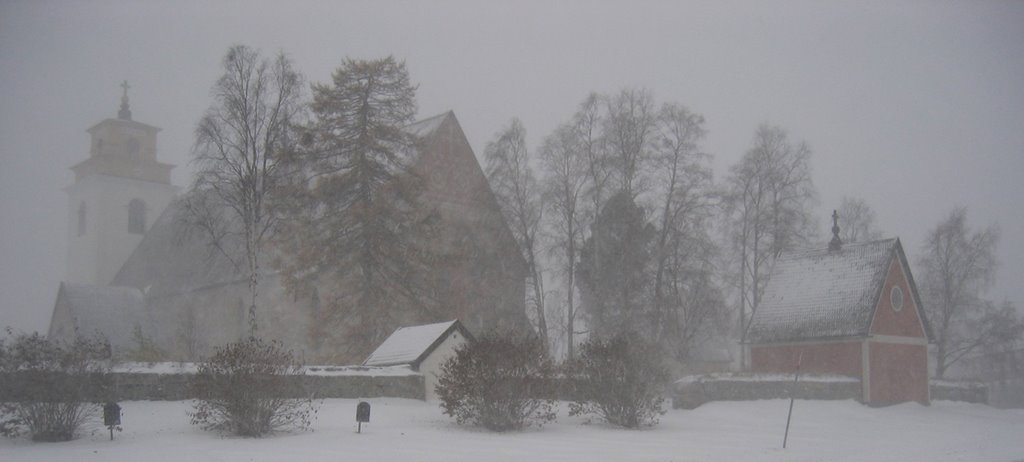
Both luck and common sense must have taken leave of me somewhere in Finland. I’ve been in Luleå less than two days and every time I step onto a bus it’s a new adventure. I set out yesterday in a snowstorm to see Gammelstad. It was cold and very windy and snowing horizontally. I climbed onto a crowded bus (Saab, of course) and watched attentively as each stop came up. I didn’t want to miss mine. Everyone was animated by the storm; talking while they took off or put on hats and gloves. There was a girl with a cat and three of her friends, a very large deaf woman who kept making phone calls while trying to hang on to a rather cumbersome wall shelf, two women with large strollers and man in his early twenties sitting in front of me who couldn’t manage to get his fingers far enough into his ears to block them all out. I got off at Gammelstad’s something or other and followed this agitated young man across the snowy road. To my right was a huge roundabout and to my left a petrol station. I went left to get directions. The woman at the counter pointed me toward a young man stocking the shelves. He spoke English and was very kind and told me that Gammelstad proper was three more stops down the road. He gave me a map and said it was only a kilometer but cautioned “It is not such nice weather.” I told him I didn’t mind walking and thanked him as I went back out into the storm.

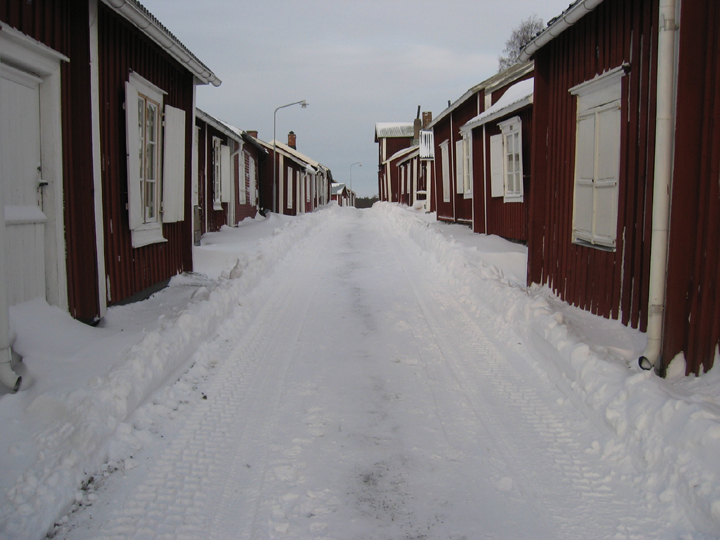
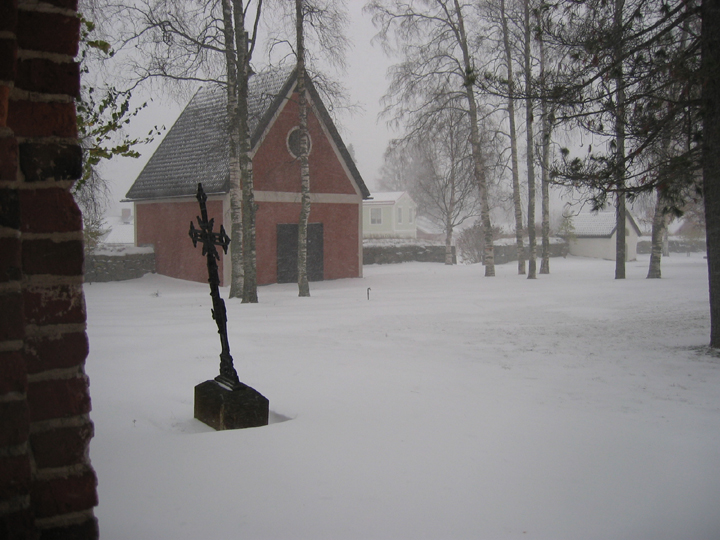
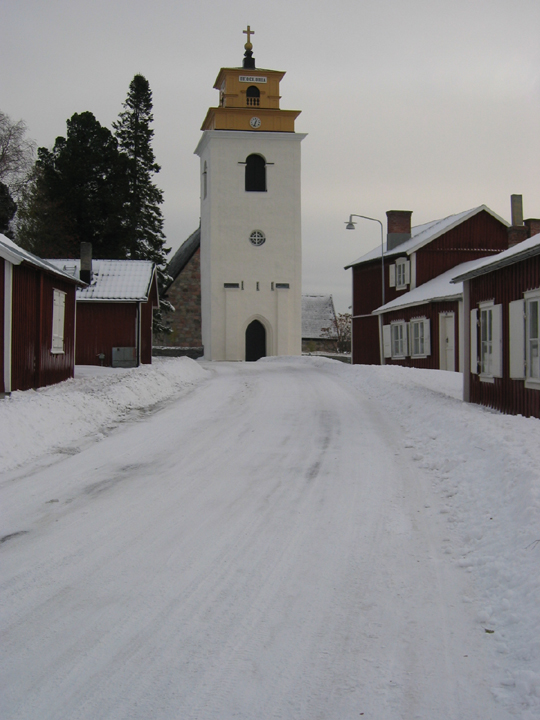
There were lots of cars and no sidewalks on the road I was to follow. The snow was ankle deep and I walked into a very strong wind. It was snowing so hard (follow the link to video) that I almost walked right by Gammelstad! It appeared out of nowhere and I turned onto a narrow lane and walked up a hill packed with little red cottages. It seemed as if most of the wooden buildings had all huddled together behind the more orderly ones fronting the street. They all had white trim and shutters and lace curtains were hung in the windows. Most had large stones for front steps. A huge old stone church and a big white belltower sat on top of the hill. Except for an occasional passing car, there wasn’t a soul in sight. The church was locked up and the tourist office was closed along with all of the shops and cafés. Further evidence of my singular brilliance. I took pictures, mostly of the blowing snow, until the next bus came.

As the day progressed the storm just seemed to grow and my attempts to wander Luleå were severely hampered. I gave in and returned to my room, where the snow was now a quarter of the way up the window. The storm blew all night but the sky was clear when I woke up this morning and so I decided to go back to take some more pictures and sketch before leaving town. A bus bound for the hospital, via Gammelstad came ten minutes before the No 9 that I had taken yesterday. The driver didn’t speak English but nodded when I said Gammelstad so I paid her and sat down. This time I wouldn’t get off until I saw those little red cottages. The bus wound through neighborhoods where all the houses were either yellow or red, past two lakes and finally stopped in front of an enormous building covered by a glass roof. Everyone got off and the driver turned and just looked at me. We were at the end of the line and apparently I had missed my stop. Could getting to Gammelstad really be this much of a challenge? I gathered my things and stood up and she tried to explain to me that another bus would come in three minutes and to get off at ‘Centrum’. I told her I understood and turned to get off the bus but she told me to sit down. In three minutes we were back on the road.


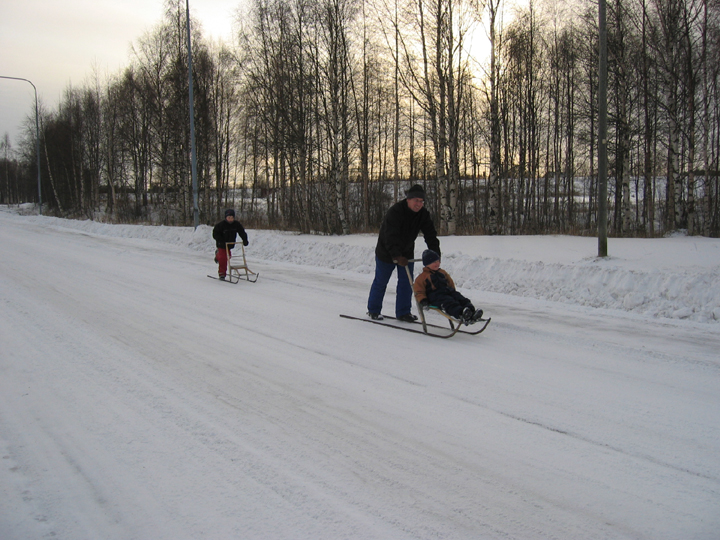
‘Centrum’ came, and I got off the bus. I knew where I was from the day before and I walked toward the church on the hill. I passed a man with two children on delicate foot sleds and they smiled at me as I took their picture. The town was quiet and nestled in yesterday’s snow and I wandered up and down the tiny streets and photographed the winding passageways between the buildings. The church, even in a city would have been massive and imposing but at the top of the hill in this Lilliputian village its presence was exaggerated. A family was gathering there for what looked like a christening and so I was able to get a glimpse inside. A single bay of white plastered walls terminated in a beautifully painted apse. It was a very reduced gothic of ribbed vaults and pointed arches and uncharacteristically thick walls. It would have been the perfect place to wait out yesterday's storm. I circled the entire village and then stopped next to Margarta’s Wardshus to sketch the buildings that followed the main road as it wound its way out of town. Getting there had taken a great deal of doing and as long as the weather held I was in no hurry to get back on the bus.